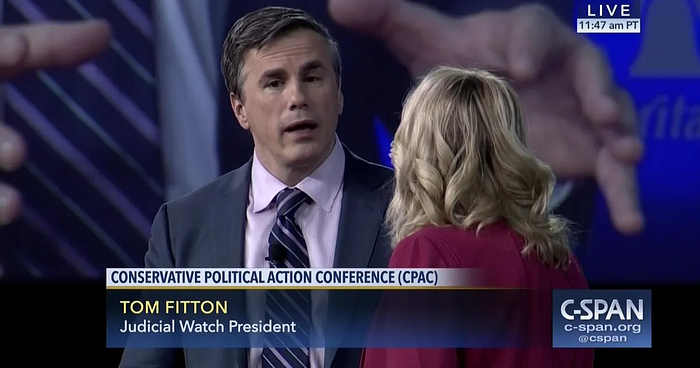
Tom Fitton is an idea. In 1989, William S. Lind formalized the principles of what he called “Fourth Generation Warfare.” Without getting too technical, fourth generation warfare is all about messing with the minds of your opponent, and getting ahead of their decision-making processes.
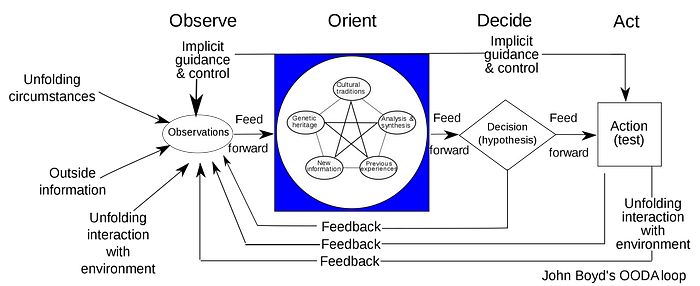
Lind drew heavily on the ideas of Col. John Boyd, who described the idea of the “OODA loop,” or the mental process of “observe, orient, decide, act” used by pilots. Boyd argued that if you could get inside of this OODA loop, and act faster than an opponent, you can outpace their ability to make sense of the world.
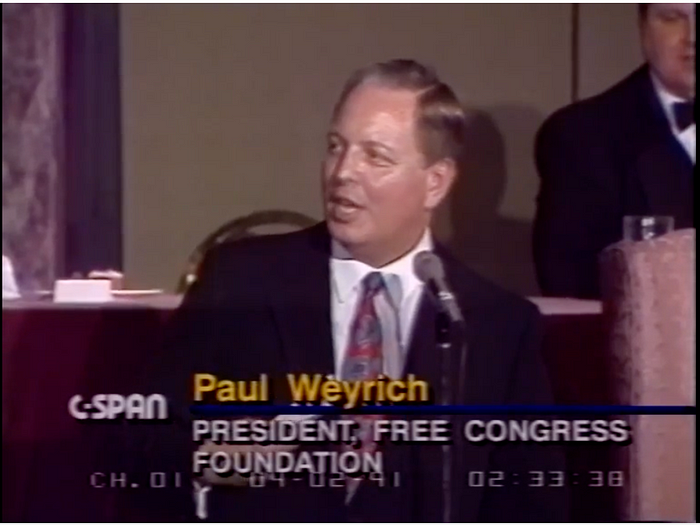
William Lind partnered up with Paul Weyrich, founder of both the Heritage Foundation and the Council for National Policy, to bring Fourth Generation Warfare techniques to Republican organizing strategy. Among the ideas they had in the early 1990’s was to lay the groundwork for a generation of future leaders.
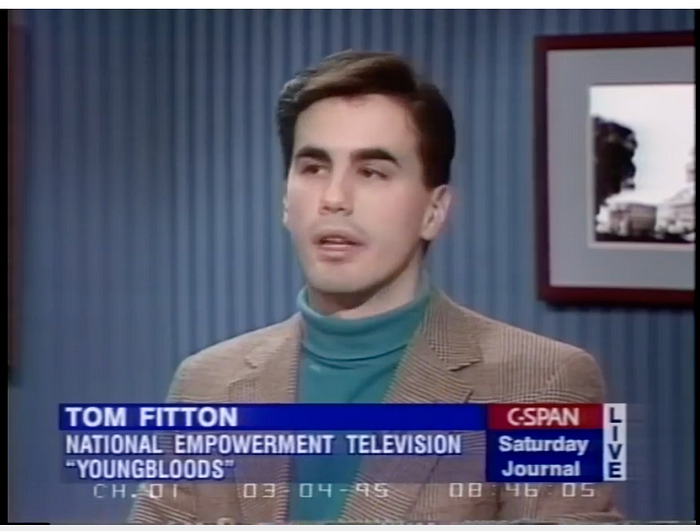
In late 1993, Weyrich founded National Empowerment Television, a cable channel that reached 11 million homes at its peak. In addition to shows that featured Weyrich, the Family Research Council, and the NRA, they featured a show called “Youngbloods,” (pitched as NET’s answer to MTV’s “The Real World”) featuring aspiring conservative stars Tom Fitton (described as “the resident flamethrower”), along with Norah O’Donnell, and Heather Nauert. Arianna Huffington served briefly as a spokesperson for the network in 1995.
1993年末、ウェイリッチは「ナショナル・エンパワーメント・テレビジョン」を設立し、ピーク時には1,100万世帯が視聴したケーブルチャンネルとなりました。ウェイリッチ、Family Research Council、NRAを特集した番組に加え、保守派のスターを目指すトム・フィトン(「専属の火炎放射器」と呼ばれている)、ノラ・オドネル、ヘザー・ナウアートらが出演する「Youngbloods」(MTVの「The Real World」に対するNETの回答)という番組を放送しました。1995年には、アリアナ・ハフィントンが一時的にスポークスマンを務めました。
Over time, the principles of fourth generation warfare came to dominate Republican politics. In October 2004, Ron Suskind reported in the New York Times this anecdote about an interaction with a senior G.W. Bush adviser.
In the summer of 2002, after I had written an article in Esquire that the White House didn’t like about Bush’s former communications director, Karen Hughes, I had a meeting with a senior adviser to Bush. He expressed the White House’s displeasure, and then he told me something that at the time I didn’t fully comprehend — but which I now believe gets to the very heart of the Bush presidency.
The aide said that guys like me were “in what we call the reality-based community,” which he defined as people who “believe that solutions emerge from your judicious study of discernible reality.” I nodded and murmured something about enlightenment principles and empiricism. He cut me off. “That’s not the way the world really works anymore,” he continued. “We’re an empire now, and when we act, we create our own reality. And while you’re studying that reality — judiciously, as you will — we’ll act again, creating other new realities, which you can study too, and that’s how things will sort out. We’re history’s actors . . . and you, all of you, will be left to just study what we do.”
This exchange captures exactly what Fourth Generation Warfare is all about. It’s about creating reality and forcing others to react to it, placing opponents at a continuous strategic disadvantage.
In 1980, the Council on Foreign Policy and its magazine Foreign Affairs was one of the most influential policy-crafting organizations in the country, if not the world. While it maintained a liberal orientation, its open membership and wide-ranging mission as a think-tank allowed it to secure a tax exempt 501(c)(3) status, thus securing an advantage with individual and corporate donors.
1980年当時、Council on Foreign Policy(CFR:外交問題評議会)とその雑誌『Foreign Affairs(フォーリン・アフェアーズ)』は、世界はおろか米国でも最も影響力のある政策立案機関のひとつでした。リベラルな方向性を維持しながらも、会員をオープンにし、シンクタンクとしての幅広い使命を果たすことで「501(c)(3)」の免税資格を得て、個人や企業の寄付者に有利な立場を確保していました。
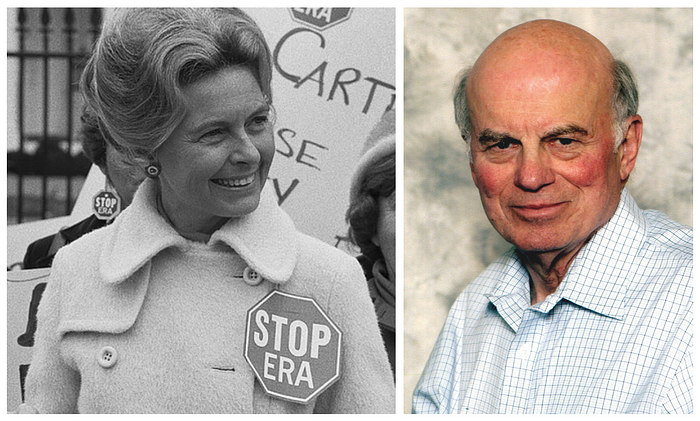
Paul Weyrich and his allies, direct mail wizard Richard Viguerie and constitutional lawyer turned ERA-opponent Phyllis Schlafly decided they needed a comparable organization in order to advance their long term strategies. In 1981, they created the Council for National Policy (CNP) as a long-term counterweight. It was funded by Weyrich’s patrons, the Hunt brothers and by Joseph Coors, with whom Weyrich had founded the Heritage Foundation, Western Goals, and ALEC, with similar objectives.
But the CNP was something of a different beast from anything that had been previously tried by Weyrich and his allies. Think-tanks like Heritage Foundation were one thing, but CNP was all about action. The goal was to network powerful individuals, place them for long term success, and enact specific policies with clear outcomes.
CNP in its early days was a hotbed of fundraising for conservative causes like the Nicaraguan Contras, and Jack Singlaub and Oliver North were participants and speakers in many early CNP meetings. While CNP met only a few times per year, and its membership was secret, it was laying the groundwork for decades of conservative activism.
Other CNP participants in years to come read like a who’s who of the Trump years: Kellyanne Conway, Steve Bannon, Ginni Thomas, Michael Flynn, Herman Cain, Ted Cruz, Ken Cuccinelli, Brent Bozell, Betsy DeVos, Erik Prince, Donna Rice Hughes, Tom Fitton, Sidney Powell, and dozens more.
And by 2017, the CNP membership would include one more figure prominently associated with January 6th: Ali Akbar, or as he has become more popularly known after he changed his name due to his criminal record, Ali Alexander.
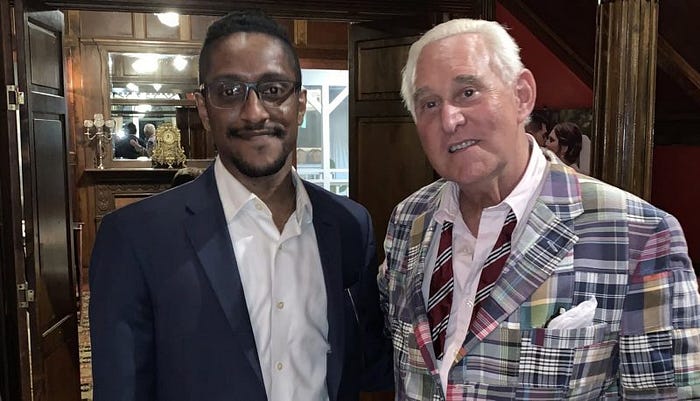
The night before the 2016 election, a PAC run by Alexander and co-founded by an old friend of Larry MacDonald’s, Roger Stone, received $60,000 from Robert Mercer. His group, called “Stop The Steal,” issued guidance on November 7, 2016: “Your help is needed, it is respected, and it is appreciated… With this movement, you will one day be able to tell your grandchildren about what you did to help SAVE AMERICA!!!”
2016年の選挙の前夜、アレクサンダーが運営し、ラリー・マクドナルドの旧友であるロジャー・ストーンが共同設立したPACが、ロバート・マーサーから6万ドルを受け取っていた。「Stop The Steal」という名の彼のグループは、2016年11月7日にガイダンスを出しました。「あなたの助けは必要とされ、尊敬され、感謝されています...この運動によって、あなたはいつの日か自分の孫に、アメリカを救うために何をしたかを伝えることができるでしょう!」
ストーンとアレクサンダーは、2018年にも「Stop The Steal」を復活させ、特にフロリダでは、共和党のリック・スコットと民主党のビル・ネルソンの間で行われた連邦上院選の投票再集計に反対する活動を行いました。そして実は、ストーンは2000年の時点でフロリダで、ブッシュ対ゴアの裁判でこうした作戦を実践していました。"ブルックスブラザーズの暴動 "と呼ばれる事件に参加していたのです。
By 2020, Alexander and Stone had a well-oiled machine at the ready to organize around Trump’s losing turn in the November 3 election. The CNP leadership had decided as early as February 2020 that the election would need to be contested at the state level, and they pursued that strategy well before the first vote was even cast.